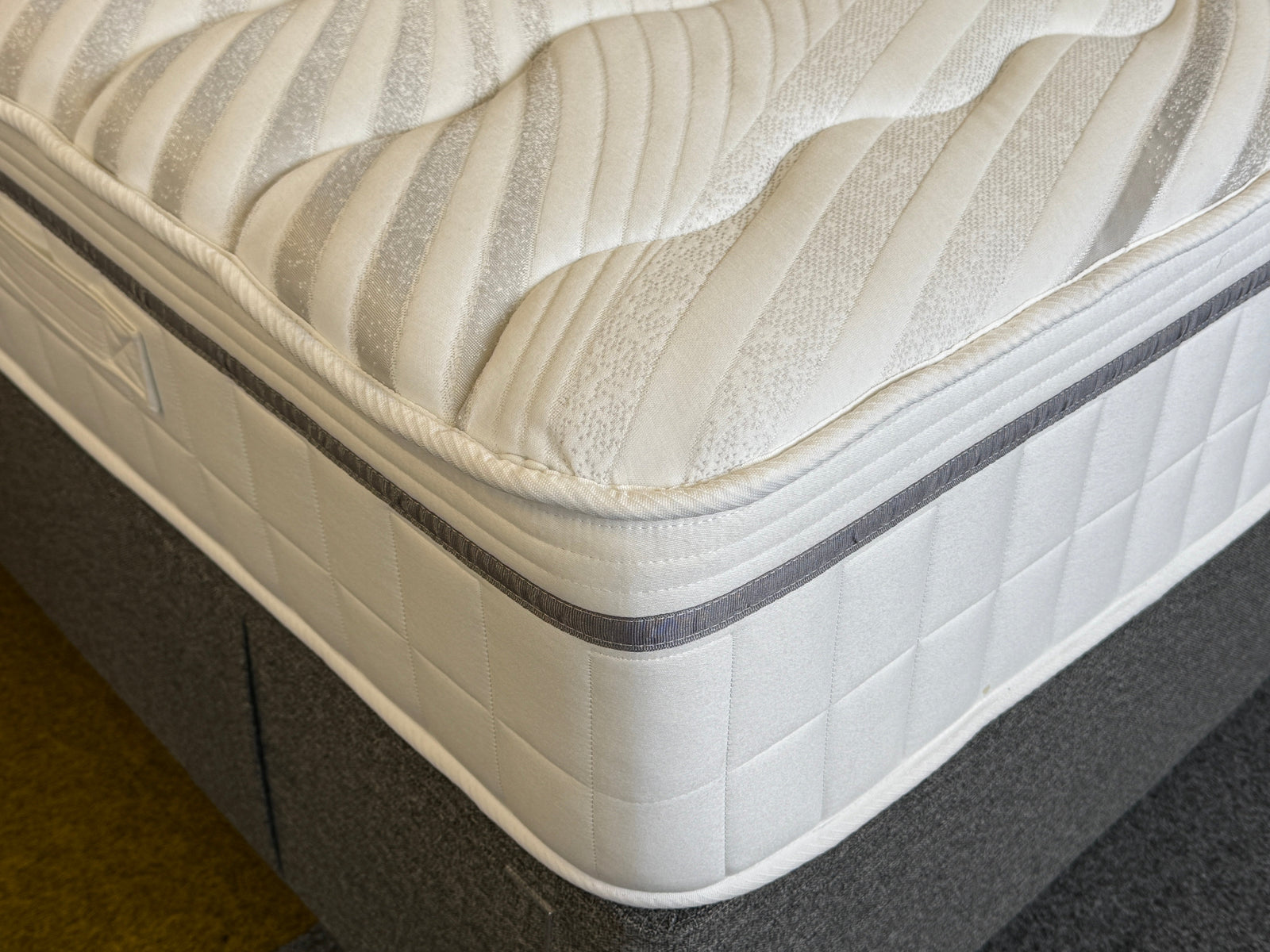
Short answer: seven to ten years for a decent one. Cheaper open-coil mattresses can be done in five. A well-made pocket-sprung mattress that is rotated and kept on a proper base can go past ten. But most people keep theirs too long, because the decline is slow enough that you stop noticing.
Signs it is finished
You sleep better away from home. Hotels, a relative's spare room, a caravan. If you wake up less stiff somewhere else, it is not the pillows.
There is a dip where you sleep. Strip the bed and look along it from the foot. A visible hollow, or a ridge down the middle between two people, means the springs have gone and no amount of turning will bring them back.
You can feel individual springs. Through the top, with your hand. The comfort layers have compressed.
You roll towards your partner. One side has softened more than the other and the bed has a slope.
It creaks, or it is noticeably heavier. A mattress absorbs a surprising amount of moisture over a decade. If it feels heavier to turn than it used to, that is why.
You wake with aches that ease within an hour of getting up. Pain that is worst on waking and improves once you are moving is the classic sign the bed is the cause.
What shortens a mattress's life
A worn-out base is the big one. A new mattress on a sagging divan or a bed frame with broken slats will follow the base within a year. If the base is as old as the mattress, replace both.
Never rotating it. Sleeping in the same spot on the same side every night compresses that spot. Rotating head to toe every three months spreads the wear.
Jumping on it, sitting on the same edge every day to put your shoes on, and bending it to get it round a corner all break springs and stitching.
What makes one last
Pocket springs over open coil. Open-coil mattresses are one connected wire mesh; when one part goes, it all goes. Pocket springs are independent and fail gracefully.
A firm, flat base. A divan or a bed frame with slats no more than 7cm apart.
Rotating it every season, and turning it too if it is a two-sided mattress. Our Albert and the Sealy Grasmoor are two-sided; most modern pocket-sprung mattresses are no-turn and only need rotating.
A mattress protector. Not for the mattress's springs, but to keep moisture and skin out of the fillings.
Guarantees, honestly
A five-year guarantee covers manufacturing faults: a spring that breaks, stitching that gives. It does not cover normal softening, which every mattress does in the first few months, and it does not mean the mattress will be as good in year five as year one. Treat the guarantee as a floor, not a lifespan.
If yours is showing the signs above, come and lie on a few in Clydebank. Our own Signature range is pocket-sprung, British-made and starts at £299 for the Albert, and the Sealy and Zero Gravity ranges go up from there. Bring a photo of the old base and we will tell you whether it needs replacing too.
Paul James Home, Co-op Department Store, Clydebank. Monday to Saturday 9 to 5. 0141 266 0400.