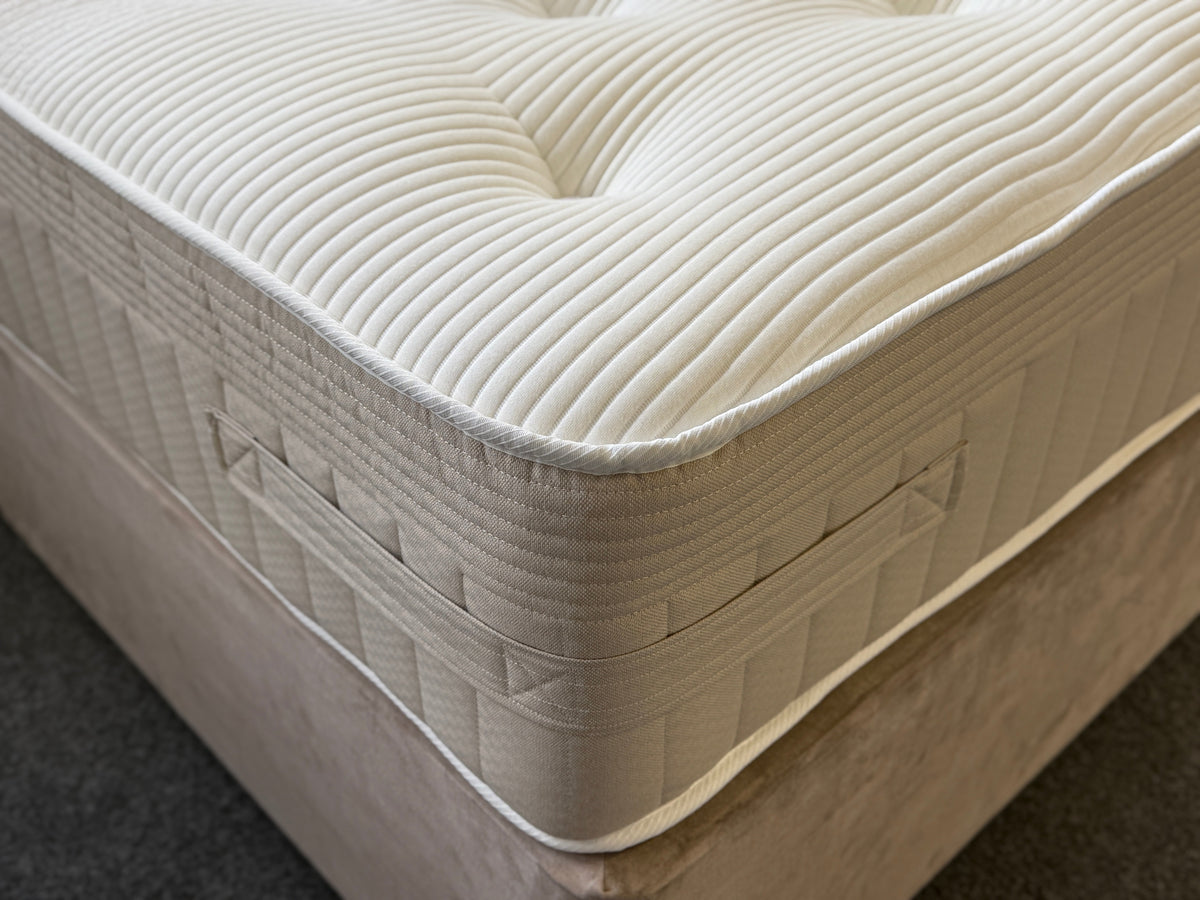
Short answer: nothing official. There is no standard, no test and no body that certifies a mattress as orthopaedic. Any manufacturer can print the word on the label. In practice it has come to mean one thing: firm. And firm on its own is not what a sore back needs.
We run a bed showroom in Clydebank and somebody asks for an orthopaedic mattress most weeks, usually because a doctor, a physio or a neighbour told them to. This is the conversation we have with them, written down.
Where the word came from
Orthopaedics is the branch of medicine dealing with bones and joints. Decades ago a few manufacturers started putting the word on their firmest mattresses to suggest a medical benefit. It stuck, other makers copied it, and it became shorthand for “hard bed”. No orthopaedic surgeon signs off on any of them.
What a sore back actually needs
Two things, and they pull in opposite directions.
Support is the mattress keeping your spine in a straight line when you lie on your side, or in its natural curve when you lie on your back. Support comes from the spring unit underneath, not from how the surface feels. A good pocket-sprung unit gives it; a cheap open-coil mattress can sag in the middle within a year, and a sagging middle is the most common cause of a back that is worse in the morning than at night.
Pressure relief is the top layers giving way under the hips and shoulders, the two points that carry most of your weight on your side. If the surface is too firm they take the whole load, go numb, and you turn over to relieve them. Every turn is a stretch of deep sleep lost. A mattress that lets you stay put all night is doing more for you than one that feels solid.
A mattress sold as orthopaedic usually gives you the first without the second. That is why so many people buy one and swap a sore back for a sore hip.
The terms, in plain English
Firmness. How hard the surface feels when you lie on it. It is a preference and a body-weight question, not a medical one. Heavier people need a firmer mattress to get the same support; lighter people sink less and can go softer.
Medium-firm. What most of the back-pain research and most physios actually recommend, and what most of the people who come in asking for orthopaedic go home happiest on. Firm enough underneath to support, soft enough at the surface to lie on your side.
Pocket springs. Hundreds or thousands of individual springs, each in its own fabric pocket, each moving on its own. This is what gives real support: the springs under your hips compress while the ones under your waist do not, so your spine stays level. The count (1000, 2000, 3400) is a rough guide to quality, not a rule.
Pressure-relieving layer. The foam or fibre layer on top of the springs that does the giving-way. Memory foam is the best known and it works, but it holds heat. Newer materials like the Zero Gravity layer in our own Signature range give the same pressure relief without the warmth.
Zoned. Springs of different strengths in different areas, firmer under the hips and softer under the shoulders. Sounds clever, is hard to feel in practice, and is pointless if two people of different sizes share the bed.
Edge support. Whether the mattress holds firm when you sit on the side of it. Matters a lot if you use the edge of the bed to get up. Look for hand side-stitching or an encapsulated (foam-walled) edge.
So what should you ask for?
Not a word on a label. Tell the shop three things: how you sleep (side, back, or both), roughly what you weigh, and what hurts in the morning. Then lie on a medium-firm pocket-sprung mattress with a pressure-relieving top, in the position you actually sleep in, for ten minutes. That tells you more than any description.
If two of you share the bed and you are different sizes, both of you lie on it. That is the single most useful thing you can do in a bed shop, and hardly anyone does it.
What we point people at
For most people who come in asking for orthopaedic, it is the Garscadden 3400: medium to firm, 3,400 pocket springs, hand side-stitched so the edge holds when you sit on it, and a pressure-relieving Zero Gravity layer on top. Made in Britain to order in about two weeks. Anyone lighter, or who finds it a touch firm on their side, usually goes for the Ted 1000.
Both are on the floor in our showroom inside the Co-op Department Store in Clydebank, ten minutes from Glasgow. Come in, lie on them, take your time. No appointment needed. If you would rather read first, we have written a longer guide for over-60s and bad backs.
Paul James Home, Sylvania Way, Clydebank G81 1EA. Monday to Saturday 9 to 5. 0141 266 0400.